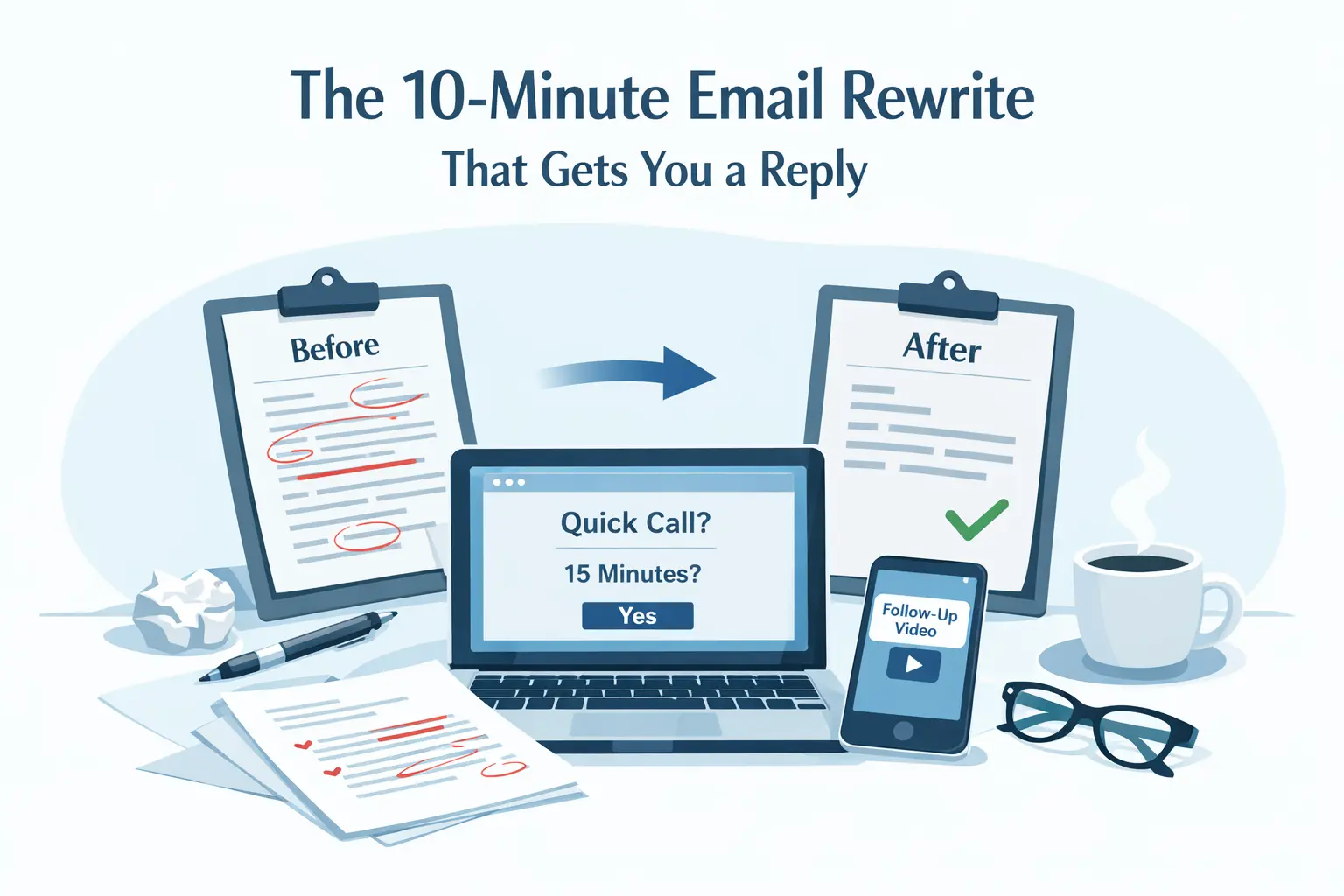
Most emails don't fail because the idea is bad. They fail because the first draft is too long, too vague, or too focused on the sender. The fix is almost always the same: cut the fluff, front-load the point, and make it easy to say yes.
Here's what that looks like in practice.
Cold outreach: before and after
Before:
Hi Sarah, I hope this email finds you well. I wanted to reach out because I came across your company and thought there might be some potential synergy between our organizations. We offer a platform that helps teams collaborate more effectively, and I'd love to schedule a call to discuss how we might be able to help your team.
After:
Hi Sarah, I noticed your team doubled headcount this year (congrats). That kind of growth usually breaks internal communication fast. We help teams like yours keep decisions visible without adding more meetings. Worth a 15-minute call this week?
The first version is 60 words of nothing. The second is specific, proves you did your homework, and asks for something small.
Follow-ups: before and after
Before:
Hi, just wanted to follow up on my previous email. I know you're busy, but I wanted to circle back and see if you had a chance to review my proposal. Please let me know if you have any questions.
After:
Hi Sarah, quick follow-up. I put together a 2-minute breakdown of how this would work for your team specifically: [link]. Happy to jump on a call if it's easier.
Follow-ups work when they add something new. Repeating "just checking in" gives the recipient nothing to respond to.
Client emails: before and after
Before:
Hi team, I wanted to provide an update on the project. We've been making good progress and things are moving along nicely. There are a few items that still need to be addressed, and I think we should discuss those at our next meeting. Let me know your thoughts.
After:
Hi team, project update: design is done, dev starts Monday. Two open questions before we move forward: 1) Do we ship the mobile version in v1 or v2? 2) Who owns QA sign-off? Can you weigh in by Thursday so we stay on track?
The rewrite puts the status up front, names the blockers, and gives a deadline. No ambiguity, no wasted reading time.
The pattern
Every rewrite above follows the same three moves:
- Lead with the point. Put the most important thing in the first sentence.
- Cut the filler. Remove anything that doesn't earn its place.
- End with a clear ask. Tell the reader exactly what you need and when.
That's it. Ten minutes of editing, and your reply rate goes up.
Let WindowSill do the rewrite
This is the kind of revision that WindowSill handles for you, right where you're typing. Select your draft text in any app, and WindowSill's AI text tools pop up. Pick "Improve," "Shorten," or set the tone to "Professional" or "Straightforward." You'll see a diff of the changes before you accept anything, so you stay in control.
No copying into a separate tool. No switching windows. Just better emails, inline, in about ten seconds.
Try WindowSill free and see the difference on your next email.